

STORMSKERRY MAJA
This is a large-scale domestic production, which can be considered as one of the largest domestic productions of the 2010-2020 period. The 19th century world of Stormskerry's brought to the present day through modern filmmaking.
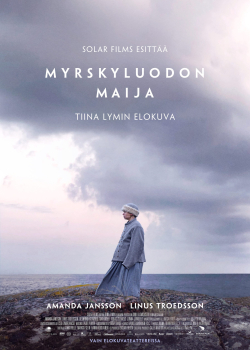
Stormskerry Maja is a touching story of a strong woman and the challenges she faces on a stormy island. Based on the novel of the same name by Anni Blomqvist, the film is set in coastal Finland in the 19th century. Young 17-year-old Maja marries Janne, a fisherman, against her will. Maja's life on Stormskerry is full of challenges and adversity: as a fisherman's wife, she has to cope with her husband's long absences at sea and look after her family alone. But Maja has grown into a strong-willed and independent woman, unafraid to take on the harsh archipelago. Maja and Janne share a strong bond and a love that has deepened over time. Janne supports his wife in her endeavours and understands that the strength of a family comes from joint efforts.
Stormskerry Maja is a story of will, strength and love in the face of adversity.
ROLES INCLUDE:
AMANDA JANSSON
LINUS TROEDSSON
DESMOND EASTWOOD
TONY DOYLE
TOBIAS ZILLIACUS
JONNA JÄRNEFELT
AMANDA KILPELÄINEN ARVIDSSON
DIRECTOR'S STATEMENT
Stormskerry Maja is a film whose time is now. It is a powerful story of a young woman blossoming at a time when women were not allowed to do so. Maja is a story that everyone should see right now, when there is so much controversy going on and the world is in the throes of upheaval. The story creates a picture of an extraordinary individual who, through extraordinary and harsh circumstances, was given the opportunity that everyone should have. To be themselves emotionally, sexually and functionally, to use their full potential and have the courage to speak out: "I'm able, I can, I dare".
At the heart of the film is Maja's attitude to the world around her, a harsh landscape where she is in direct contact with the forces of nature: the sea, the rock and love. Inside Maja, the myths, magic and legends of the old, slowly fading world, the spirits of the water and the ominous birds of the sky, the shackling rules of Christianity and the norms and customs of society live side by side in perfect harmony. Maja escapes them by living with her family on a cave far out to sea. There she learns to stand her ground and live as she pleases. To act in the best interests of herself and her family.
The almost unbearable adversity that life throws at her makes Maja strong. She never breaks, but finds new sources of strength within herself to fight on. She is truly at one with nature and those around her. The sea, which tragically takes Maja's child and her husband, also gives Maja sustenance. In the end, Maja does something that women of that time did not do. She and her children set up a kind of business. She has the courage to take out a new loan and buy a sailing ship. She trusts the return on her investment, based on calculations she has made herself.
The film is set in the mid-19th century, but its twists and turns are not unfamiliar to today's audiences. The visual aspect emphasises the real, concrete, subjective experiences of the characters: what the sea feels like, how the grass rustles under bare feet, what the skin of a loved one feels like. The characters are portrayed as real people, with tangled hair and scratched hands, wet skirt beads or the divine light of the sun on their faces. They are just like us, but in a different time. Close-ups are used extensively, as well as showing the vast, immense landscape that the unique island nature can offer. Nature is one of the characters in the film. It is part of Maja, and Maja lives in genuine contact with nature.
References, especially visual ones, include Andrea Arnold's Wuthering Heights or Jane Campion's Piano, the latter as both a visual and a narrative reference. Narratively, the film is divided into three parts. The sections are not acts but thematic units of the main character's life, which support the narrative form to a greater or lesser extent. They are the stages of Maja's growth. The first part could be about a girl becoming a woman, the second about a woman alone and the third about Maja growing to her full potential. Dividing the film in this way makes it easier to deal with long periods. Between each part, we jump far ahead in time.
For me, this film is the biggest challenge and the most fascinating story of my career. The film is harsh and warm, hard and soft. It is full of visual beauty and great emotion, and at the same time it is small and small-scale. Everything that life is. It is a film that has been missing, at least here in Finland. A great film about a woman who wins by being herself. Who is a real hero. Maja deserves to be the lead of the film.
Tiina Lymi, director
PREMIERE IN FINLAND
19.1.2024
DURATION
2h 44min
RATED FOR AGE
12+
DIRECTOR AND SCRIPT
Tiina Lymi
PRODUCERS
Jukka Helle, Hanna Virolainen and Markus Selin
CO-PRODUCER
Gustav Oldén
EXECUTIVE PRODUCER
Calle Marthin
CINEMATOGRAPHY
Rauno Ronkainen F.S.C.
SET DESIGN
Otso Linnalaakso
COSTUME DESIGN
Auli Turtiainen
MAKE-UP DESIGN
Kaisa Pätilä
SOUND DESIGN
Kirka Sainio
MUSIC
Lauri Porra
EDITOR
Joona Louhivuori F.C.E.
TV AND STREAMING RIGHTS
MTV, MTV Katsomo, TV4 (Sweden)
DISTRIBUTION
Nordisk Film